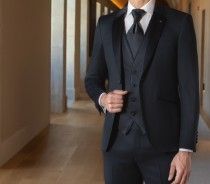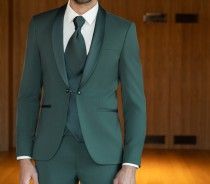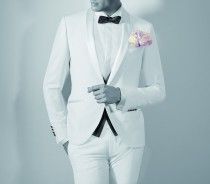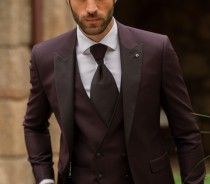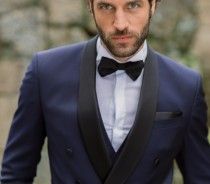

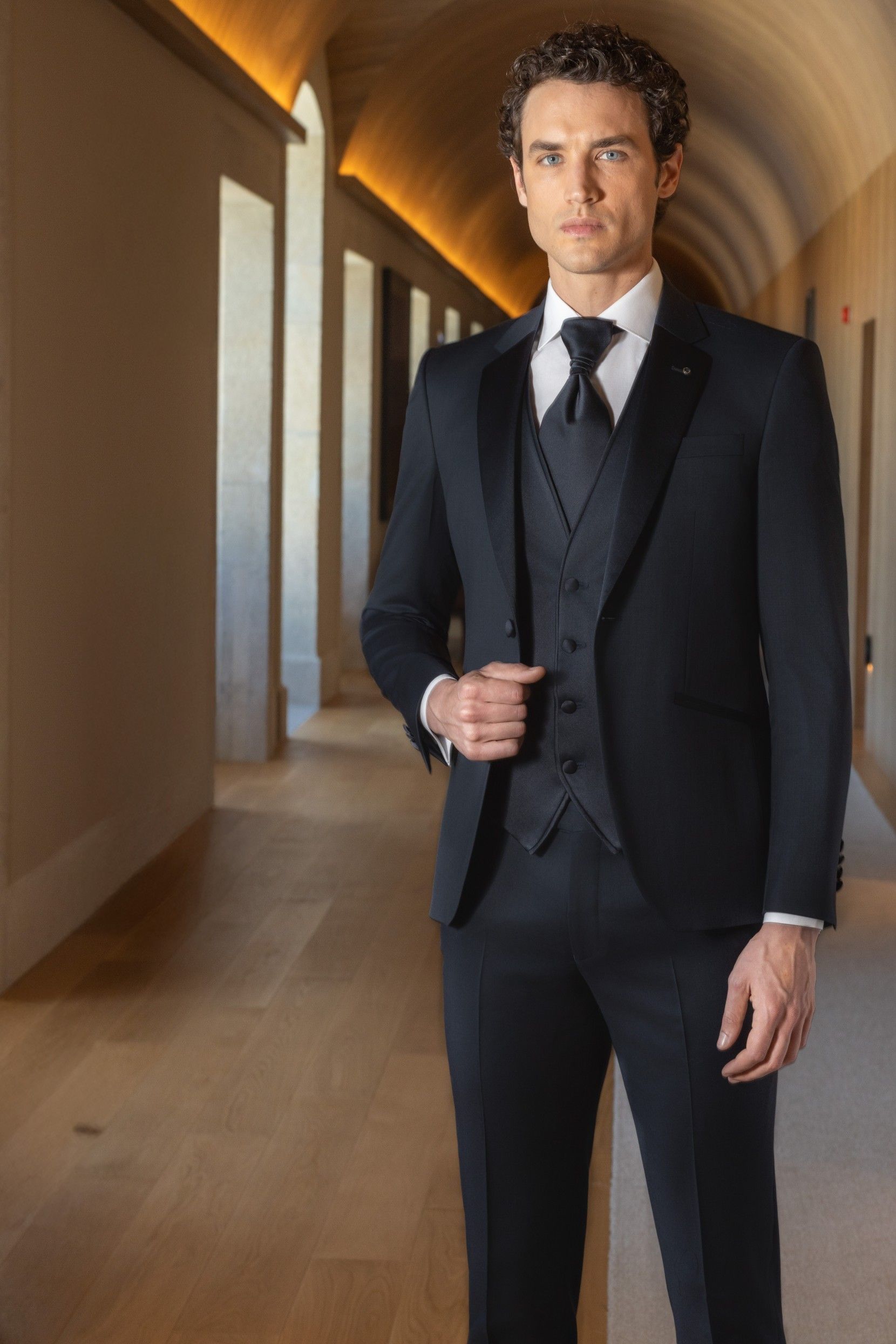
At Thomas Pina, that impression has a name. La Linea, our theme this season, begins with an old tailoring truth: the eye doesn't read clothes, it reads lines. Every suit is a composition of them, running down the body, across the shoulders, along the lapel and over the back. Placed well, they organise a man's presence before he says a word. Placed carelessly, they cut him into pieces.
On a wedding day, when every angle is photographed and every step is watched, those lines matter more than ever. Here is how to read them, and what to ask for at your fitting.


The vertical line: where height begins
The eye follows vertical lines and reads them as height. The more continuous the line from collar to shoe, the taller and calmer a man appears. That is why a suit worn tonally, with shoes and socks close to its depth of colour, always looks longer than one interrupted by strong contrasts.
The trousers do much of this work. A sharp crease draws a line down each leg. A waistband that sits at the natural waist, rather than low on the hips, lengthens the leg. And the hem should meet the shoe with a single soft break, or none at all. Cloth that pools over the shoe in several folds breaks the line at exactly the point where it should finish.
The shoulder line: the horizon of the suit
If the vertical line gives a suit its height, the shoulder gives it its horizon. Everything else hangs from it. A good shoulder is clean and natural, with the seam ending where your own shoulder ends. Too wide, and the jacket looks borrowed. Too narrow, and it pinches the whole silhouette inward. A well-placed shoulder line is the reason some men look composed even when standing still, which, on a wedding day, is most of the time.
The lapel line: an arrow pointing somewhere
Lapels are lines with intent. A peak lapel points up and out, towards the shoulders, lifting the eye and broadening the frame; it is the most ceremonial of the classic shapes. A notch lapel is quieter and more versatile. A shawl lapel draws a single unbroken curve from collar to button, softer and unmistakably made for celebration. And a mandarin collar removes the lapel altogether, leaving one pure vertical line at the front.
Where the lapels meet matters as much as their shape. That meeting point decides the depth of the V across the chest. A single button opens a long, clean V that lengthens the torso. Two buttons are the most versatile choice. Three close the V and shorten it, which is rarely what a groom needs. The right stance is the one that suits your proportions, and finding it is exactly what a fitting is for.
The line from behind
Here is a detail most grooms forget: for much of the ceremony, the guests see your back. While you face the person you are marrying, the room is looking at the line from your collar to the hem of your jacket.
That line should fall clean. The collar of the jacket should rest against the shirt collar, with no gap between them. The back should lie smooth, without horizontal folds that suggest a jacket too tight, or loose vertical ripples that suggest one too large. The vents should close flat when you stand. At your fitting, ask to see yourself from behind. It is the view everyone else will have.
The small lines that finish the drawing
Once the main lines are in place, the details complete the composition. Fasten the jacket when you stand and open it when you sit: closed, it draws one line from shoulder to waist. Let the tip of the tie meet the top of the waistband, so the eye reads one unbroken line from collar to shoe. Show a little shirt cuff, about a centimetre, at the end of each sleeve, a fine horizontal stroke that gives the arm its finish. And keep the pocket square crisp and simple. On a day full of movement, precision reads as calm.
The shared line
A wedding photograph is rarely of one person. Beside the groom, the dress carries the movement: fabric that sways, catches the light and changes with every step. The suit's role is the opposite. It should be the still, clean line that holds the composition together. Not a competing statement, but a frame. Choose a colour and texture that complement the dress rather than imitate it, and let the lines do the rest. The most elegant grooms understand that presence is sometimes a matter of restraint.


Your questions
Which lapel style makes you look taller?
Peak lapels, which point upward towards the shoulders and lift the eye. A single-button jacket helps too, because it opens a longer V across the chest.
Should a groom wear a single-breasted or double-breasted suit?
Both are correct. Single-breasted is cleaner and draws a longer vertical line; double-breasted adds formality and presence, but needs to stay fastened. Choose by your proportions and the formality of the day.
How long should a groom's tie be?
The tip should reach the top of the trouser waistband. Shorter cuts a line across the stomach; longer disappears below the waistband and looks careless.
Should wedding suit trousers have a break?
A single soft break, or no break at all. Several folds of cloth over the shoe shorten the leg and interrupt the line.
What should I check from behind at a fitting?
That the jacket collar sits against the shirt collar, the back is smooth without folds, and the vents close flat when you stand.
La Linea is not a trend. It is the quiet architecture beneath every well-dressed man, and on your wedding day it is the first thing people will see, even if they never put a name to it. Book your fitting with Thomas Pina, and let us draw yours.